
Creative Photo Adventures - Welcome & Logistics Pack
Rajasthan & Varanasi Photography Tour
All information in this document is provided in good faith and, to the best of our knowledge, was accurate at the time of writing. Details such as entry requirements, prices, opening hours and health guidance can change between now and the start of the tour, so please treat this as a helpful starting point rather than the final word, and check the official links provided closer to your departure date. Guidance on vaccinations and other medical matters is general in nature and does not constitute medical advice: please speak to your GP, a travel health clinic, or a relevant travel health authority about your own circumstances. Most of the practical information below (passport rules, vaccination funding, insurance, and so on) is written from a UK perspective, so if you are joining us from outside the UK, please check the equivalent guidance for your own country. We will continue to add to and update this document between now and departure, so it's worth revisiting before you fly.
Welcome to Your India Photography Tour
This is your welcome pack for the Rajasthan & Varanasi Photography Tour, running from 28th October to 11th November 2026. It covers everything from visas and vaccinations to currency, safety, packing and language, all specifically for this itinerary, which takes in Delhi, Varanasi, Agra, Fatehpur Sikri, Jaipur, Barli village and Jodhpur.
Introduction to Photography in India
Few destinations reward a camera the way India does. Over the course of this tour you'll photograph Mughal architecture at dawn, the ghats and cremation grounds of the Ganges at Varanasi, the pink and blue old cities of Jaipur and Jodhpur, and rural life in the Rajasthani countryside. The light, colour and sheer density of daily life on display make this one of the richest places in the world for travel and street photography.
A few cultural points are worth knowing before you go. Modest dress is expected at religious sites (shoulders and knees covered, and a head covering for all gurdwaras and some temples), and shoes are removed before entering most places of worship, so slip-on footwear is genuinely useful. The right hand is traditionally used for eating, giving and receiving, so try to hand things to people, including money, with your right hand. Public displays of affection are best kept low key. Most people you'll meet, from stallholders to sadhus, are used to cameras and are often happy to be photographed, sometimes with real warmth and enthusiasm, but as with anywhere, a smile and a moment's eye contact before you raise the camera goes a long way. More on the etiquette of photographing people is covered later in this document, under Street Photography and Privacy.
This document is detailed and includes several reference tables, so it's best read on a desktop computer rather than a phone.
Visas
UK passport holders need a visa to enter India. There is no visa-on-arrival for British citizens, so this needs sorting before you fly. India is not in the EU or the Schengen area, so none of the Schengen visa rules apply here.
Almost all UK travellers use the e-Visa system, which is a straightforward online application with no need to visit an embassy or consulate. For a trip of this length, the 30-day tourist e-Visa is the one you want.
- Apply online at the official government portal: indianvisaonline.gov.in/evisa/tvoa.html. This is the only official site: be wary of third-party sites that charge a large mark-up for the same service.
- You'll need a digital passport-style photo (plain white background) and a scan of your passport's photo page.
- Processing is typically a few working days, but we'd recommend applying at least a month before travel to leave plenty of margin, and to have it done well before the pre-trip questionnaire goes out.
- Make sure the dates on your visa comfortably cover 28th October to 11th November 2026, including your outbound flight date if you're flying out on the 27th as recommended.
If you're unsure how the requirements apply to you (for example, if you hold a different type of passport, or have previously held Indian nationality), the High Commission of India in London is the best point of contact.
Sian will also have sent you a guide to obtaining your visa which you can also find here: Visa Guide.
Entry Requirements
Alongside your visa, there are a couple of extra steps to complete before you arrive:
- e-Arrival card: foreign nationals arriving in India must complete an online e-arrival card before reaching immigration. This can be done up to 72 hours before you land, at indianvisaonline.gov.in/earrival. It's not a visa in itself, so you'll still need your approved e-Visa as well.
- Self-declaration health form: India currently asks all international arrivals to complete a Self-Declaration Form via the Air Suvidha portal, up to 24 hours before arrival, at airsuvidha.civilaviation.gov.in. Completing this in advance avoids delays at the airport.
- Getting your passport stamped: make sure the immigration officer actually stamps your passport on arrival. You'll need to show this stamp when you leave the country.
On the question of what border officials might ask for: some countries routinely ask visitors for proof of accommodation, a return flight ticket, or evidence that you can support yourself financially during the visit. For this tour, we will send you full accommodation details shortly before departure, and your return flight booking confirmation is your proof of onward travel. In all my own visits to India, leading tours over several years, I have never once been asked to produce any of this at the border, but it's sensible to have PDFs or printouts to hand just in case.
Hotels in India are required to register foreign guests with the local Foreigners Regional Registration Office, using your passport and visa details. This is handled by the hotel at check-in and needs no action from you beyond having your passport with you.
For the full, current official guidance, see the FCDO entry requirements page for India and the Indian Bureau of Immigration.
Passport Validity
To enter India, your passport must:
- Be valid for at least 6 months beyond your arrival date in India (so valid until at least early May 2027).
- Have at least 2 blank pages for the immigration stamp.
Do check the actual expiry date printed in your passport rather than going from memory. This is particularly worth double-checking if you're on an older passport that was renewed early: passports issued between 2018 and September 2018 sometimes had up to 9 extra months added onto the expiry date from the previous passport, but those extra months are no longer valid for calculating the 10-year passport life and can catch people out when calculating validity for entry to some countries. If your passport is anywhere close to the 6-month cut-off, or is low on blank pages, it's worth renewing well ahead of the trip rather than risk being refused boarding.
You can check and renew your passport at gov.uk/renew-adult-passport.
Vaccinations
There's no vaccination certificate required to enter India from the UK (the certificate requirements for yellow fever and polio only apply if you're arriving from a country where those diseases are a risk). That said, a proper travel health check is strongly recommended for a trip like this.
Please check TravelHealthPro's India page and book an appointment with your GP, practice nurse or a travel clinic at least 2 to 3 months before departure, since some vaccines need to be given as a course over several weeks. As a general guide, current recommendations for most UK travellers to this itinerary include:
- Hepatitis A and typhoid, recommended for most travellers to India.
- Being up to date with routine UK vaccinations, including tetanus/diphtheria/polio.
- Hepatitis B and rabies are sometimes recommended depending on individual risk and length of stay; India does report rabies in domestic animals (including street dogs, which you'll see a lot of), so it's worth discussing with your nurse, particularly if you might have unplanned contact with animals.
- Malaria: Delhi, Agra, Varanasi and Rajasthan are all classed as low risk for malaria. The usual advice for low-risk areas is bite avoidance rather than tablets, but do check this with your travel health provider based on your own health.
- Dengue: No vaccine is available for this, but precautions using repellents is recommended.
In the UK, some travel vaccines are available free on the NHS: this currently includes polio (as a combined booster), typhoid, hepatitis A and cholera. Others, such as hepatitis B, rabies and Japanese encephalitis, are usually only available privately if you need them purely for travel. Your GP practice can tell you which of these it offers.
It's a good idea to carry a printed or digital copy of your vaccination record with you, particularly if you've had anything unusual done for this trip.
Useful links: TravelHealthPro: India and NHS: Travel Vaccinations.
General Health
IMPORTANT: Never drink the tap water, don't even clean your teeth using it and avoid getting it in your mouth when showering.
Looking after your tummy in India: If you wish to try street food, we would strongly recommend it has been cooked in hot oil in front of you. If it is a fruit, it is best to stick with those that can be fully peeled. Drinking tea is usually safe as the water has been boiled. It is common to be offered chai (milky tea with spices) by shop owners and others you meet on the journey - you may wish to try it if offered. Do not drink from any bottles that may have had their seal tampered with or have ice in drinks of unknown origin. Look for wet plates or cutlery which may have tap water on them. Do not have drinks with ice, unless this is at our hotels. Try not to be too paranoid about what you’re eating in India. Food hygiene is significantly better than it used to be and our local guide will only take us to eateries he trusts. Go local and try the local dishes.
Delhi's air quality can be genuinely poor in late October and early November, worsened by stubble burning in Punjab/Haryana plus firework smoke around Diwali, which falls during this trip. If you have asthma or another respiratory condition, it's worth discussing this with your GP before you go and considering packing any usual medication in larger quantities than normal. A mask is also prudent if you may suffer from asthma.
We'd suggest packing a small first aid kit, including:
- Antiseptic cream and plasters, plus a small bandage.
- Painkillers (paracetamol or ibuprofen).
- Diarrhoea treatment (such as loperamide) and oral rehydration sachets.
- Antihistamines, for insect bites or minor allergic reactions.
- Any personal prescription medication, in its original packaging, with a spare supply split across your hand luggage and hold luggage in case one bag goes astray.
Pharmacies (chemists) are widely available in all the cities on this itinerary and are generally well stocked, but in my experience over-the-counter medication in India often costs noticeably more than the equivalent in the UK, so it's worth bringing what you think you'll need rather than relying on buying it there. Pharmacists are usually knowledgeable and can advise on minor ailments without needing to see a doctor.
The sun is strong throughout this trip, especially in the Rajasthan desert. Pack a good sunscreen (factor 30 or higher), a sun hat, and lip balm with SPF. Rajasthan mornings and evenings, particularly around Jodhpur and Barli, can be genuinely cold in early November, so see the What to Pack section below for layering advice.
Insects and Repellents
Mosquitoes are present throughout the itinerary, more so in Varanasi and around water, and can be active during the day as well as at dusk and dawn. Good bite avoidance is your best protection.
Worth buying before you leave the UK:
- A DEET-based repellent (30% to 50% DEET is effective and widely available from UK pharmacies and outdoor shops).
- Permethrin spray, if you want to treat clothing in advance, which lasts through several washes.
- A few plug-in or portable mosquito deterrent devices for hotel rooms, if you find these effective.
Insect repellents are also sold locally in pharmacies and general stores in every city on this route, including familiar international brands, so you can always top up in India if you run low. Loose, lightweight long sleeves and trousers in the evenings offer good extra protection with no downsides for a hot climate.
Travel Insurance
Comprehensive travel insurance is mandatory and needs to be in place from the point of booking, not just from your departure date. Please make sure your policy covers:
- Trip cancellation and curtailment.
- Flight and travel delays.
- Baggage, including your camera equipment specifically (many standard policies cap single-item or "valuables" cover well below the value of a camera and lenses, so you may need to declare your kit or add specified item cover).
- Medical treatment and repatriation, ideally with a high medical limit given the cost of private healthcare in India.
To compare policies and find one that suits your circumstances, a good starting point is MoneySavingExpert's travel insurance guide.
Weather
Late October and early November is one of the best times of year to visit this part of India. The monsoon is well and truly over, humidity is low, and skies are generally clear, though air quality in the cities (especially Delhi and Agra) can still be hazy.
- Delhi and Agra: daytime highs of around 28 to 32°C, dropping to a comfortable mid-teens overnight by early November.
- Varanasi: similar daytime highs, cooling noticeably in the mornings by the start of November, when riverside boat rides at dawn can feel genuinely chilly.
- Jaipur and Jodhpur (Rajasthan): warm, dry days around 28 to 32°C, with a much bigger day-to-night swing than the cities further east. Expect overnight lows in the mid-teens, occasionally cooler in the desert around Barli and Jodhpur.
Rain is very unlikely at this time of year across the whole route. The main practical consideration is the day-to-night temperature swing, particularly in Rajasthan, so pack layers rather than relying on daytime warmth alone.
Time Zone
India is on Indian Standard Time (IST), UTC+5:30, year-round. India does not observe daylight saving time, so the clocks will not change at any point during your trip.
By the time you fly out in late October, UK clocks will already have gone back to GMT for the winter (this happens on the last Sunday of October), so for the whole of this trip India will be a consistent 5.5 hours ahead of the UK. Note the half-hour offset when working out call times home or setting alarms.
Sunrise and Sunset Times
Several days on this itinerary are built around dawn or dusk shoots, so here are sunrise and sunset times for each date, calculated for wherever the group will be that day. Times are given in local 12-hour format (IST) and are accurate to within a minute or two; treat them as a reliable planning guide rather than to-the-second precision, as atmospheric conditions can shift the exact moment slightly.
| Date | Where | Sunrise | Sunset |
|---|---|---|---|
| Wed 28 Oct | Delhi | 6:30 am | 5:39 pm |
| Thu 29 Oct | Delhi | 6:30 am | 5:38 pm |
| Fri 30 Oct | Delhi (morning) | 6:31 am | 5:37 pm |
| Fri 30 Oct | Varanasi (from midday) | 6:04 am | 5:18 pm |
| Sat 31 Oct | Varanasi | 6:05 am | 5:17 pm |
| Sun 1 Nov | Varanasi | 6:05 am | 5:17 pm |
| Mon 2 Nov | Varanasi (early morning) | 6:06 am | 5:16 pm |
| Mon 2 Nov | Agra (from midday) | 6:28 am | 5:33 pm |
| Tue 3 Nov | Agra | 6:29 am | 5:33 pm |
| Wed 4 Nov | Agra (morning) | 6:30 am | 5:32 pm |
| Wed 4 Nov | Jaipur (from evening) | 6:38 am | 5:41 pm |
| Thu 5 Nov | Jaipur | 6:39 am | 5:41 pm |
| Fri 6 Nov | Jaipur | 6:40 am | 5:40 pm |
| Sat 7 Nov | Jaipur (sunrise Jal Mahal) | 6:40 am | 5:39 pm |
| Sat 7 Nov | Barli (from afternoon) | 6:48 am | 5:51 pm |
| Sun 8 Nov | Barli (morning) | 6:49 am | 5:51 pm |
| Sun 8 Nov | Jodhpur (from afternoon, Diwali) | 6:51 am | 5:51 pm |
| Mon 9 Nov | Jodhpur | 6:52 am | 5:50 pm |
| Tue 10 Nov | Jodhpur (morning) | 6:52 am | 5:50 pm |
| Tue 10 Nov | Delhi (from afternoon) | 6:39 am | 5:29 pm |
| Wed 11 Nov | Delhi (departure) | 6:40 am | 5:29 pm |
Worth noting: Varanasi, being the furthest east on this route, has noticeably earlier sunrise and sunset times than Jaipur and Jodhpur further west, even though all of India shares one time zone. That's why the dawn boat rides in Varanasi start earlier in clock time than the sunrise shoots later in the trip out west in Rajasthan.
Currency and Money
The currency is the Indian Rupee (INR, ₹). It's a closed currency, meaning you cannot officially buy rupees in the UK before you travel and cannot take rupees out of India when you leave. However you will find several specialist currency exchanges do stock rupees. You are unlikely to have them confiscated if found, but it is a risk. This isn't unusual for the region, it just means a little more planning:
- Bring sterling cash, or another major currency, to exchange after you land, or rely on ATM withdrawals once you arrive. Both are straightforward at airports, banks and hotels in every city on this route. Only use ATMs located at proper banks - our guide will help with this.
- ATMs are widely available in Delhi, Agra, Jaipur, Jodhpur and Varanasi. Your UK bank or card provider will likely charge a foreign transaction fee and/or a flat withdrawal fee, so it's worth checking this and considering a specialist travel card before you go, ideally ordered at least 14 days before departure to allow time for delivery and activation.
- Cards are widely accepted in hotels, larger restaurants and shops in the cities, though smaller stalls, markets and rural areas (including Barli village) are cash-only.
- If you're asked whether to pay in GBP or INR on a card machine (dynamic currency conversion), always choose to pay in the local currency (INR). The GBP option almost always comes with a worse, inflated exchange rate baked in.
- Keep some smaller denomination notes and coins handy for tips, rickshaws and small purchases: large notes can be hard for street vendors to change.
For comparing exchange rates and travel money options before you leave the UK, see MoneySavingExpert's travel money comparison.
Tipping
Tipping is customary and genuinely appreciated in India, and forms a meaningful part of the income for guides, drivers and hotel staff. 1 INR = 1 pence (roughly).
As a rough guide for this trip:
| House-keeping | 50 INR per day. | Housekeepers and maids are among the hardest working hotel staff. It’s common to say thanks for great service with a small daily tip. |
| Luggage attendants / Porters | 50 INR / per bag | When you arrive at your hotel in India you’ll probably need help getting your bags to your room. It’s customary to give a small tip to porters so don’t forget to have some small change when checking in!Its common that it will be a different person to take your bags from the car to hotel reception and from reception to room! Both will want tipping. |
| Rickshaw drivers | 600 INR covering 2 people | This is for the Pink Rickshaw drivers, otherwise its just 20 INR for short trips |
| Photography on streets | tbc | We will discuss the nuance of this with our guide when on the ground in India and will mostly like all put a little money in a kitty and the guide will sorts tips for us. |
| Restaurants | 10% of the bill | |
| Our escort guide | 1200-1500 INR per person per day | Our escort guide will be with us throughout the tour. Not only does he conduct sightseeing, but he also ensures all of the logistics runs smoothly behind the scenes. |
| Local driver | 400-500 INR per person per day | Our driver will accompany us throughout the tour and will have many long drivers ahead. He will also be an expert in navigating the chaotic city traffic! |
Tipping amounts are always at your discression and we will talk more about this during the trip.
Safety, Crime and Scams
The vast majority of visits to India proceed entirely without incident, and past guests on this tour have consistently come home with nothing but positive stories. We highlight a few things to be aware of below simply so you can recognise them and carry on enjoying the trip, not because incidents are common.
A few scams and situations that pop up with tourists in the cities on this route:
- Unofficial guides and "helpful" strangers: particularly around major sights and railway stations, people may offer unsolicited help, claim your hotel is closed or full, or offer to guide you somewhere "better". Politely decline and stick with our group guides.
- Gem and souvenir scams: in Jaipur especially, tourists are sometimes offered "bargain" gemstones with a story about reselling them at home for profit. It's not a real opportunity: only buy from established shops if you're interested in gems or jewellery.
- Boat ride overcharging in Varanasi: agree a price per person clearly before you get in a boat, and note whether it's per person or for the whole boat.
- Overpricing generally: negotiate at markets and with unlicensed vendors, and check restaurant menus have prices listed.
A note specific to photographers: several of the best vantage points on this trip involve uneven ground, wet stone steps, or a drop, particularly the ghats in Varanasi (which can be slippery, especially near the water's edge and after any rain) and some fort viewpoints in Rajasthan. Please take care with your footing, especially when looking through a viewfinder rather than where you're walking, and be extra cautious near crowds at the ghats during the evening aarti ceremonies, when large numbers of people gather in a confined space.
General safety habits that apply anywhere: use hotel-arranged or app-based transport (Uber and Ola both operate in these cities) rather than hailing on the street at night, keep valuables and spare cards separate from your main wallet, and keep a photo or scan of your passport and visa somewhere separate from the originals.
The main national emergency number, 112, and other useful numbers are listed in the Emergency Services and Numbers section below.
What Not to Shoot
India has genuine legal restrictions on photographing certain subjects, rooted in the Official Secrets Act and the Defence Act, and these are actively enforced, particularly around any current regional tensions. As a general rule, do not photograph:
- Military personnel, vehicles, camps, checkpoints, or any defence installation.
- Police stations, police checkpoints, and (in most cases) individual police officers, without asking first.
- Government buildings, especially anything that looks official or has visible security.
- Airport security areas, runways and aircraft from the ground (photography inside civil terminal buildings themselves is generally permitted, but keep cameras away from security checkpoints and staff).
- Border areas: none of this itinerary goes near an international border, but it's worth knowing as a general rule for India.
These aren't empty rules. People have been detained, even briefly, for photographing sensitive sites, so if in doubt, don't. If a security guard or official asks you to stop or delete an image, it's best to comply calmly rather than argue.
At religious sites on this itinerary, photography rules vary by location:
- At Jama Masjid in Delhi, entry fee and photo permit is included.
- At the Taj Mahal, tripods are not permitted on the main grounds, and a professional photography fee applies if you're using anything beyond a standard still camera for personal use (video cameras and certain professional setups need separate permits, arranged well in advance).
- Inside temples, gurdwaras and mosques generally, look out for signage. Photography is often restricted in inner sanctums or during specific ceremonies, even where it's fine in the main courtyard.
Privacy
India's constitution recognises a right to privacy, and this has been interpreted by courts as extending to protection against unauthorised intrusion into someone's private life. In practice, for a street photographer this plays out as follows:
- Photographing people in public places (streets, markets, ghats, festivals) is generally accepted and rarely causes issue, but there's no blanket legal "right to photograph" in the way some other countries frame it.
- If someone clearly does not want to be photographed, respect that. Continuing to photograph someone against their wishes can, in principle, be treated as a privacy infringement.
- Using someone's image for commercial purposes (advertising, selling prints of them, and similar) legally requires their consent. For personal use, sharing on social media, or editorial and documentary purposes, verbal consent or a friendly nod is generally considered sufficient practice, though it's not a hard legal requirement in the way commercial use is.
- Be especially thoughtful around anyone in a vulnerable situation: mourners at the cremation ghats, people mid-prayer or ritual, and children in particular.
The short version: ask when you reasonably can, read the room, and if someone waves you away, move on. This isn't just good legal practice, it also tends to produce better photographs and better experiences all round.
Street Photography
India is one of the most rewarding countries in the world for street photography, and this itinerary is built around that. A few practical tips for shooting on this trip specifically:
- Approach with warmth, not stealth. A smile, a nod, or a moment of eye contact before raising your camera tends to get a far better reaction than shooting from the hip. Many people you meet, from spice sellers to sadhus, are genuinely happy to be photographed and will sometimes strike a pose without being asked.
- Slow down at the ghats. Varanasi rewards patience over the hunt for a single "hero" shot. Sit, watch the rhythm of a place for a few minutes, and the pictures tend to come to you.
- Be sensitive around cremation ceremonies. Photography is generally tolerated at a respectful distance around Manikarnika and Harish Chandra ghats, but never photograph the immediate cremation process, mourners in obvious distress, or the deceased. Our guides will advise on the etiquette in the moment.
- Carry small notes. A few rupees as a thank you, especially for someone who's clearly posed for you or spent time helping, is appreciated and considered normal practice, not obligatory but a nice touch. We will liase with our guide concerning tipping photo subjects.
- Markets and bazaars (Chandni Chowk in Delhi, the old city in Jaipur, the bangle and havelis streets) are wonderful for candid work, but stay aware of your bag and pockets in denser crowds.
Environmental and Animal Protection
Please use common sense while out and about: take litter with you if there's nowhere to dispose of it properly, avoid doing anything that might disturb wildlife or damage the natural or historic environment, and don't remove anything, whether that's a stone from a stepwell, a flower from a temple offering, or anything else, from the places we visit.
Creative Photo Adventures partners with Nature First, and we ask everyone travelling with us to keep their principles in mind: prioritise the wellbeing of a place and its subjects over getting the shot, and educate yourself about the places you photograph. We've also partnered with Just One Tree, and a tree will be planted in your name for joining this tour.
We do not support or encourage any activity that uses animals for tourist entertainment, including elephant rides, photo props involving chained or restrained animals (a common sight with monkeys or snakes in some tourist areas), or performing animals of any kind. Nothing of that nature is included in this itinerary: the Amber Fort visit, for instance, is by 4x4 jeep rather than elephant, which is both kinder and, in our view, a nicer way to arrive. You will see working animals in daily use around Rajasthan, such as camels and bullocks, which is a normal part of rural life rather than a tourist activity; use your own judgement and our guides' advice on when it's appropriate to photograph them.
You'll also encounter monkeys around some of the forts and ghats (Jodhpur and Varanasi especially). Please don't feed them: it encourages aggressive behaviour towards other visitors, and monkeys are known to snatch anything left within reach, including camera straps, sunglasses and food.
Emergency Services and Numbers
India's national emergency number is 112, which connects to police, fire and ambulance services and works from any phone. The older individual numbers below still work in most places too.
| Service | Number |
|---|---|
| National emergency number (police, fire, ambulance) | 112 |
| Police | 100 |
| Fire brigade | 101 |
| Ambulance | 102 / 108 |
| Tourist helpline (English and other languages) | 1363, or 1800-11-1363 toll-free |
| Women's helpline | 1091 / 181 |
Note that India does not have a coastline or high mountain terrain on this itinerary, so there's no coastguard or mountain rescue service relevant to this trip.
For anything more serious, such as a lost or stolen passport, a serious accident, or an arrest, contact the British High Commission in New Delhi:
- Address: Shantipath, Chanakyapuri, New Delhi 110021
- Telephone: +91 11 2419 2100
- Website: gov.uk/world/india
Food and Drink
Breakfast is included at every hotel on this trip, and other meals are included as noted on your itinerary; where meals aren't included, there's no shortage of choice, from hotel restaurants to street food stalls, and our guides can always point you towards something good nearby.
Restaurants in the cities generally open for dinner from around 7pm and stay busy until 10 or 11pm, later than a typical UK dinner service, so don't expect much of a queue if you eat at 7. Street food stalls often run from morning through to late evening.
A few local specialities to look out for on this route:
- Delhi: Old Delhi's Chandni Chowk area (which we'll walk through) is famous for street food, including parathas on Paratha Wali Gali, chaat, and rich Mughlai-style kebabs.
- Varanasi: kachori sabzi (a fried pastry with spiced lentils and potato curry) is the classic breakfast, alongside tamatar chaat, malaiyyo (a delicate seasonal milk foam dessert, if you're there when it's in season), and the city's famous lassi, particularly worth trying at one of the long-running lassi shops near the ghats.
- Agra: petha, a translucent sweet made from ash gourd, is the city's signature treat, sold in dozens of flavours.
- Jaipur and Rajasthan generally: dal baati churma is the classic Rajasthani thali dish, a combination of lentils, baked wheat dumplings and a sweet crumbled wheat dessert, along with gatte ki sabzi (gram flour dumplings in curry) and, for meat eaters, laal maas, a fiery Rajasthani mutton curry.
Bottled water is provided as part of the tour for transfers and sightseeing, and stainless steel reusable bottles will be provided for topping up with filtered water where available. If you're buying your own bottled water, check the seal is intact before drinking.
If you're vegetarian, you'll find India one of the easiest countries in the world to travel in: vegetarian food is the default in a huge number of restaurants, not an afterthought. If you have specific allergies or dietary requirements, do let us know via the pre-trip questionnaire so we can flag this to hotels and guides in advance.
Shopping
Shop opening hours vary, but as a general guide, most shops in the cities open from around 10am or 11am and stay open until 8 or 9pm, seven days a week, including Sundays. Markets and bazaars often keep similar or slightly longer hours. Some smaller, family-run shops close for one day a week, which varies by owner rather than following a fixed citywide pattern, and some businesses close early or entirely during major festivals, including Diwali itself, which falls during this trip.
For everyday shopping, supermarket-style chains such as Reliance Smart, More, Spencer's and DMart are found in the larger cities (Delhi, Jaipur and Jodhpur), though Barli village has no supermarket and only small local shops.
If you have specific dietary needs such as gluten-free, dairy-free or sugar-free food, your best bet is the bigger supermarkets and pharmacy chains in Delhi and Jaipur, along with health food shops in those cities, rather than smaller towns. It's worth bringing a supply of any specialist items you rely on regularly, since availability outside the major cities is patchy.
Public Holidays
This trip runs straight through Diwali, India's biggest festival of the year, which is a real highlight rather than a complication. In 2026, the festival period falls as follows:
- Dhanteras: Friday 6th November 2026
- Choti Diwali / Naraka Chaturdashi: Saturday 7th November 2026
- Diwali (Lakshmi Puja): Sunday 8th November 2026, which is our first day in Jodhpur, where we'll see the old city bazaars in full festive swing and enjoy a small Diwali celebration at the hotel.
- Govardhan Puja: Monday 9th November 2026
- Bhai Dooj: Tuesday 10th November 2026 (may be 11th November in some towns!)
Expect markets to be especially busy and beautifully decorated in the days leading up to Diwali, and some shops and offices (though not our hotels or transport) may close or run reduced hours on 8th November itself. Fireworks are widespread and continue for several nights around the festival, which is worth knowing if you're a light sleeper.
Astronomical Events
Diwali is traditionally celebrated on the new moon (Amavasya), and 2026's new moon falls on 9th November, right in the middle of our time in Jodhpur. That means genuinely dark skies away from city lights and firework smoke on the nights either side of Diwali, which is worth knowing if you fancy a bit of night photography in Barli village or on the outskirts of Jodhpur.
The Southern and Northern Taurid meteor showers overlap through late October and into November this year, with the Southern Taurids peaking around 5th November and the Northern Taurids around 9th November, coinciding neatly with the dark, moonless skies around Diwali. Rates are modest (a handful of meteors an hour) but the Taurids are known for producing occasional bright fireballs, so it's worth a look up if you're out after dark in Rajasthan.
There are no solar or lunar eclipses during this trip.
Clothing to Pack
Clothing-wise, think layers rather than heavy items. Days are warm throughout (high 20s to low 30s Celsius), but mornings and evenings, especially in Rajasthan, can drop into the mid-teens or lower.
- Lightweight, breathable clothing for the day: natural fabrics like cotton and linen work well in the heat.
- A warmer layer (fleece or light jacket) for early starts and evenings, particularly for the dawn boat rides in Varanasi and mornings in Barli and Jodhpur.
- Modest clothing for temples, mosques and gurdwaras: shoulders and knees covered. A light scarf is useful for covering your head where needed and doubles as sun protection.
- Comfortable, broken-in walking shoes with a good grip, given the amount of uneven ground, steps and cobbles on this itinerary. Slip-on shoes or sandals are handy for the frequent removal of footwear at religious sites. One thing to note about Varanasi is the ground can be very messy - a friend who has visited several times warned that you may want to throw your shoes away after even a short visit, so do think about this!
- A hat and sunglasses.
- A light rain jacket, more for peace of mind than expectation, as rain is very unlikely at this time of year.
Footwear
In hot weather open toe shoes or sandals are usually fine. A few places may have rough ground or a lot of litter around thus closed shoes may be preferred. Large hiking boots are not needed.
Photography Kit
- Your main camera body and lenses: a versatile mid-range 24-70/105mm zoom will cover most situations, with a wider lens 14-30mm useful for architecture and interiors, and something longer 70-200mm for candid portraits at a respectful distance.
- Spare batteries and memory cards: charging opportunities are plentiful at hotels, but having enough for a full day out is sensible, especially on the longer touring days.
- A lightweight travel tripod, bearing in mind it won't be usable at the Taj Mahal itself (see What Not to Shoot above) and may be restricted at a few other sites.
- Lens cloths and a rocket blower: dust is a genuine factor in Rajasthan.
- A dry bag or rain cover for your camera, useful for the boat rides on the Ganges.
- A head torch can be handy.
- Filters such as a polariser is handy, also a set of 3/6/10 stop filters can be handy but not often used.
- Laptop of editing and image backup: Most of our days are full so there is little time for editing.
Electricity
India runs on 230V, 50Hz, the same as the UK, so your existing UK chargers and camera battery chargers will work fine on the correct plug, no voltage converter needed. Just check the label on each charger for "INPUT: 100 to 240V" to be sure, which is standard on almost all modern phone, laptop and camera chargers.
India uses Type C, D and M sockets, all with round pins rather than the UK's flat ones, so you will need a plug adapter. Type D (three round pins in a triangle) is the most common socket, followed by the type C which the standard Euro socket; a universal travel adapter that covers India will work throughout this trip.
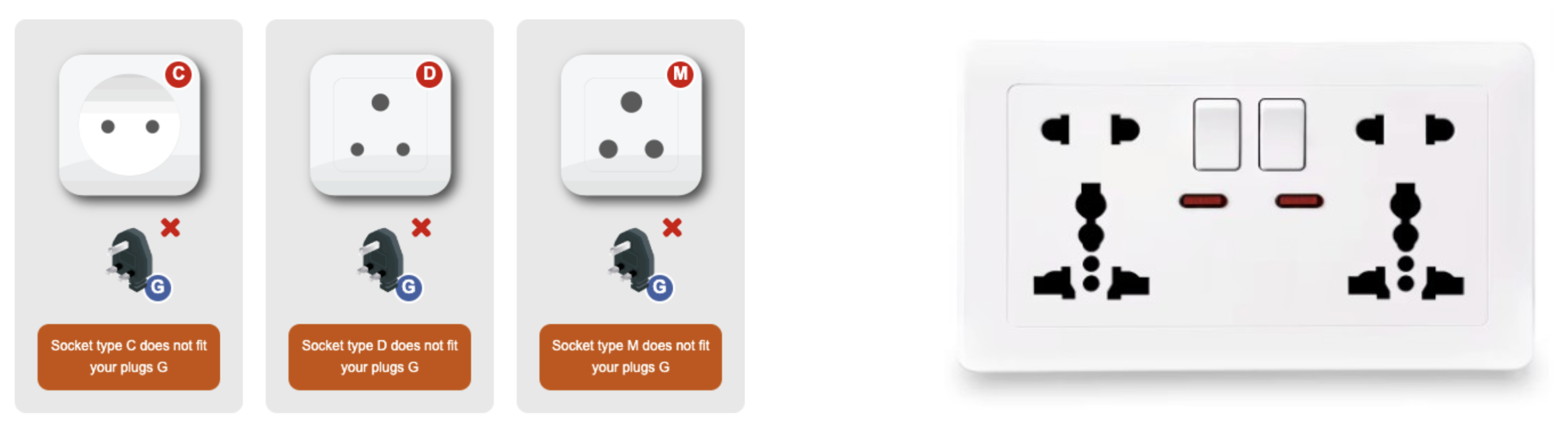
However in many hotels you will see these multi-country power sockets which will happily accept a UK plug.
Luggage
This itinerary includes several internal flights (Delhi to Varanasi, Varanasi to Delhi, and Jodhpur to Delhi), each with its own baggage allowance as noted on your day-by-day schedule. Weight limits: Flights in and out of Varanassi 15kg check-in and 7kg hand luggage. Flight from Jodphur to Delhi 20kg check-in and 7kg hand luggage. Over weight luggage will need to have a premium paid at the airport. Overall, packing light and sticking to a maximum of two bags (one hold, one cabin) will make the whole trip considerably easier, especially given the number of hotel changes.
The flight to Varanasi, there is the option to leave un-neccessary items with our tour office to lighten the load. This is left at your own risk.
Indian domestic airlines strictly enforce a one cabin bag rule, with only a small additional personal item (such as a handbag or laptop bag) generally permitted. If you normally travel with a separate camera bag and a small backpack, you may need to consolidate these into one bag for the domestic legs of this trip.
A few packing points worth knowing:
- Spare batteries and power banks must travel in hand luggage, not hold luggage, as with any flight, and Indian airport security have in some cases restricted passengers to a small number of loose batteries in hand luggage. Keep quantities sensible and batteries protected against short-circuiting (original packaging or a battery case).
- Small tools, including a tripod hex or Allen key, spare quick-release plates, or a multitool, can occasionally be confiscated at Indian airport security even in hold luggage, so it's worth packing these inside something else, or leaving them at home if you can manage without.
- Vapes and e-cigarettes can attract extra attention from Indian airport security. If you carry one, it will be confiscated at security.
- A luggage tracker (such as an Apple AirTag or similar) is a sensible addition to your hold bag, given the number of flights and transfers on this trip, making a delayed or misdirected bag much easier to locate.
- Pack a printed luggage tag with your name and phone number as a backup, in case anything electronic runs out of battery.
Drones
In short: leave it at home unless you've arranged permissions well in advance. India's drone rules are genuinely restrictive for foreign visitors. Foreign nationals need prior permission from the Ministry of Home Affairs as well as registration through the DGCA's Digital Sky platform before flying a drone in India, and flying without this is a real risk of confiscation or a fine, particularly given how many of our locations (forts, ghats, temples and city centres) sit in controlled or sensitive airspace.
None of the activities on this tour rely on drone footage, so it's not something you'll be missing out on by leaving it behind. If you do want to pursue it independently, the starting point is the DGCA Digital Sky platform, and this needs to be arranged well ahead of travel, not on arrival.
Also any satellite communications devices are banned including phones, and GPS devices such as Garmin inReach, Zoleo, Thuraya and Iridium are all prohibited.
Internet
Wifi is available at all the hotels on this itinerary, though speed and reliability can vary, particularly in Barli village. For anything time-sensitive, such as backing up photos, it's worth not relying on hotel wifi alone.
India is not in the EU, so if your UK mobile tariff includes EU roaming, that will not extend to India! Check your provider's specific rate for India, as some tariffs include a small amount of "rest of world" roaming data and calls, while others charge premium rates.
Cheapest UK option is to purchase a sim card from UK provider Lebara, who includes data roaming in India as standard. A 30 day sim card costs around £10 for 30Gb of UK/EU/India usage. Visit their web site for more details: https://aklam.io/eETUwn6f
Other option is an eSIM, which is a great way to stay connected. I have an arrangement with eSIM provider Airalo, and you can get a discount using this link: airalo.go.link/2TJjq with the code STEVEN3101. eSIMs are only supported on some newer smartphones, so it's worth checking your phone's compatibility before you buy rather than after you land.
WhatsApp Group
I'll set up a WhatsApp group for the tour around a month before we travel, so everyone can start chatting, ask questions, and get to know each other before we meet, as well as staying in touch during and after the trip. You'll be asked for permission to join this when you receive the pre-trip questionnaire. If you don't currently use WhatsApp, I'd suggest setting up an account specifically for this trip, as it's genuinely the easiest way to keep everyone in the loop, especially for last-minute logistics on the ground.
Joining Instructions
In a few weeks, you'll receive a pre-trip questionnaire from us. Sian will arrange your collection from the airport, so ensure she has your flight details. Our first meet with be at the first hotel.
Local Language
Hindi is the main language across this entire itinerary and is understood everywhere we'll be. English is also very widely spoken in tourism, hotels and by guides, so you won't be stuck, but a handful of Hindi phrases go a long way and are always warmly received. You'll also hear regional flavour along the way: Marwari and other Rajasthani dialects around Jaipur, Jodhpur and Barli, and Bhojpuri around Varanasi, though Hindi will be understood in all these places too.
Below are two tables: general travel phrases, and a second table of photography-specific phrases that should come in handy on this particular trip.
Common Travel Phrases
| English | Hindi | Pronunciation |
|---|---|---|
| Hello / Greetings | नमस्ते | Namaste |
| Goodbye | अलविदा | Alvida |
| Please | कृपया | Kripya |
| Thank you | धन्यवाद | Dhanyavaad |
| Yes | हाँ | Haan |
| No | नहीं | Nahin |
| Excuse me / Sorry | माफ़ कीजिए | Maaf kijiye |
| How are you? | आप कैसे हैं? | Aap kaise hain? |
| I am fine, thank you | मैं ठीक हूँ, धन्यवाद | Main theek hoon, dhanyavaad |
| What is your name? | आपका नाम क्या है? | Aapka naam kya hai? |
| My name is... | मेरा नाम ... है | Mera naam ... hai |
| Do you speak English? | क्या आप अंग्रेज़ी बोलते हैं? | Kya aap angrezi bolte hain? |
| I don't understand | मुझे समझ नहीं आया | Mujhe samajh nahin aaya |
| I don't speak Hindi | मुझे हिंदी नहीं आती | Mujhe Hindi nahin aati |
| Please speak slowly | कृपया धीरे बोलिए | Kripya dheere boliye |
| Where is the toilet? | शौचालय कहाँ है? | Shauchalay kahaan hai? |
| How much is this? | यह कितने का है? | Yeh kitne ka hai? |
| That's too expensive | यह बहुत महंगा है | Yeh bahut mehnga hai |
| Can you lower the price a little? | क्या आप थोड़ा कम कर सकते हैं? | Kya aap thoda kam kar sakte hain? |
| Water, please | पानी दीजिए | Paani dijiye |
| I am vegetarian | मैं शाकाहारी हूँ | Main shaakahaari hoon |
| No meat, please | मांस नहीं चाहिए | Maans nahin chahiye |
| I am allergic to nuts | मुझे मेवों से एलर्जी है | Mujhe mevon se allergy hai |
| This is delicious | यह बहुत स्वादिष्ट है | Yeh bahut swaadisht hai |
| The bill, please | बिल दीजिए | Bill dijiye |
| Where is the nearest pharmacy? | सबसे पास की दवाई की दुकान कहाँ है? | Sabse paas ki dawai ki dukaan kahaan hai? |
| I need a doctor | मुझे डॉक्टर चाहिए | Mujhe doctor chahiye |
| Help! | मदद करो! | Madad karo! |
| Where is the hotel? | होटल कहाँ है? | Hotel kahaan hai? |
| Please take me to this address | मुझे इस पते पर ले चलिए | Mujhe is pate par le chaliye |
| Turn left | बाएँ मुड़िए | Baaye mudiye |
| Turn right | दाएँ मुड़िए | Daaye mudiye |
| Straight ahead | सीधे जाइए | Seedhe jaiye |
| Please stop here | यहाँ रोकिए | Yahaan rokiye |
| Is it far from here? | क्या यह यहाँ से दूर है? | Kya yeh yahaan se door hai? |
| I am lost | मैं खो गया हूँ / गई हूँ | Main kho gaya hoon / gayi hoon |
| Can you help me, please? | क्या आप मेरी मदद कर सकते हैं? | Kya aap meri madad kar sakte hain? |
| What time is it? | क्या समय हुआ है? | Kya samay hua hai? |
| Good morning | सुप्रभात | Suprabhat |
| Good night | शुभ रात्रि | Shubh raatri |
| Congratulations | बधाई हो | Badhaai ho |
| Beautiful | सुंदर | Sundar |
| I like this very much | मुझे यह बहुत पसंद है | Mujhe yeh bahut pasand hai |
| Where can I find a taxi or rickshaw? | टैक्सी या रिक्शा कहाँ मिलेगा? | Taxi ya rickshaw kahaan milega? |
| How much to go to the airport? | एयरपोर्ट जाने में कितना लगेगा? | Airport jaane mein kitna lagega? |
| Where is the railway station? | रेलवे स्टेशन कहाँ है? | Railway station kahaan hai? |
| Is there wifi here? | क्या यहाँ वाईफाई है? | Kya yahaan wifi hai? |
| Cheers! (a toast) | चियर्स | Cheers |
| Welcome | स्वागत है | Swaagat hai |
| See you tomorrow | कल मिलते हैं | Kal milte hain |
| I am very happy to be here | मुझे यहाँ आकर बहुत खुशी है | Mujhe yahaan aakar bahut khushi hai |
| What is this called? | इसे क्या कहते हैं? | Ise kya kehte hain? |
| No, thank you | नहीं, धन्यवाद | Nahin, dhanyavaad |
| It's very hot today | आज बहुत गर्मी है | Aaj bahut garmi hai |
Photography Phrases
| English | Hindi | Pronunciation |
|---|---|---|
| May I take your photo? | क्या मैं आपकी फोटो ले सकता/सकती हूँ? | Kya main aapki photo le sakta/sakti hoon? |
| Thank you for letting me photograph you | फोटो लेने देने के लिए धन्यवाद | Photo lene dene ke liye dhanyavaad |
| Would you like to see the photo? | क्या आप फोटो देखना चाहेंगे? | Kya aap photo dekhna chahenge? |
| Where can I buy a memory card? | मेमोरी कार्ड कहाँ मिलेगा? | Memory card kahaan milega? |
| Where can I buy batteries? | बैटरी कहाँ मिलेगी? | Battery kahaan milegi? |
| My camera has been lost or stolen | मेरा कैमरा खो गया है या चोरी हो गया है | Mera camera kho gaya hai ya chori ho gaya hai |
| Can I charge my phone here, please? | क्या मैं यहाँ अपना फ़ोन चार्ज कर सकता/सकती हूँ? | Kya main yahaan apna phone charge kar sakta/sakti hoon? |
| Is photography allowed here? | क्या यहाँ फोटो लेने की अनुमति है? | Kya yahaan photo lene ki anumati hai? |
| Is a tripod allowed here? | क्या यहाँ ट्राइपॉड की अनुमति है? | Kya yahaan tripod ki anumati hai? |
| Is there a fee for photography here? | क्या यहाँ फोटो के लिए शुल्क है? | Kya yahaan photo ke liye shulk hai? |
| Where is the best view from here? | यहाँ से सबसे अच्छा नज़ारा कहाँ से दिखता है? | Yahaan se sabse achha nazaara kahaan se dikhta hai? |
| What time does the sun rise here? | यहाँ सूरज कितने बजे निकलता है? | Yahaan sooraj kitne baje niklta hai? |
| Could you stand a little to the left, please? | क्या आप थोड़ा बाएँ खड़े हो सकते हैं? | Kya aap thoda baaye khade ho sakte hain? |
| I am a photographer, not a journalist | मैं एक फोटोग्राफर हूँ, पत्रकार नहीं | Main ek photographer hoon, patrakaar nahin |
| Please don't arrest me, I was only taking a photo! | कृपया मुझे गिरफ़्तार न करें, मैं तो बस फोटो ले रहा/रही था/थी! | Kripya mujhe giraftaar na karein, main to bas photo le raha/rahi tha/thi! |
A note on the Hindi above: verbs change slightly depending on whether the speaker is male or female (shown as sakta/sakti, raha/rahi, and similar pairs), so pick whichever ending matches you. Don't worry about getting this perfect: people will understand you either way, and a genuine attempt at a local phrase is almost always met with a smile.
Interesting Facts
- The Taj Mahal, which we'll photograph at sunrise in Agra, was built by Mughal emperor Shah Jahan as a mausoleum for his wife Mumtaz Mahal, who died giving birth to their fourteenth child. It took an estimated 20,000 workers over two decades to complete.
- Varanasi is widely considered one of the oldest continuously inhabited cities in the world, with a documented history stretching back roughly 3,000 years.
- Jaipur is known as the "Pink City" because the old city was painted a terracotta pink in 1876 to welcome a visit from the Prince of Wales, later King Edward VII, and the tradition has been maintained ever since.
- Jodhpur's old city is painted a distinctive blue, traditionally linked to the Brahmin caste, though today the colour is used far more widely and is said to also help keep buildings cooler and deter termites.
- Fatehpur Sikri, which we'll pass through en route to Jaipur, was built as the Mughal capital by Emperor Akbar in the 16th century but was abandoned within about 15 years, largely due to water shortages.
- Diwali, which falls during our trip, is celebrated differently across India: in the north it commemorates Lord Rama's return to Ayodhya after 14 years of exile, while other regions mark different stories and deities.
- The Ganges, which we'll spend two days photographing in Varanasi, is considered sacred by Hindus and is personified as the goddess Ganga.
- Rajasthan is India's largest state by area, roughly the size of Germany, and much of it sits within the Thar Desert.
- Delhi's Jama Masjid, which we'll visit, was the last major architectural commission of Shah Jahan, the same emperor behind the Taj Mahal, and remains one of the largest mosques in India.
- India is home to more than 20 official languages and, by some estimates, several hundred more spoken across its states and regions, alongside a huge number of local dialects.
Any Questions?
If anything in this document isn't clear, or if something comes up that isn't covered here, just drop me an email, or ask in the WhatsApp group once it's set up closer to the trip. There's no such thing as a silly question, and I'd always rather you ask than worry.